Products Description
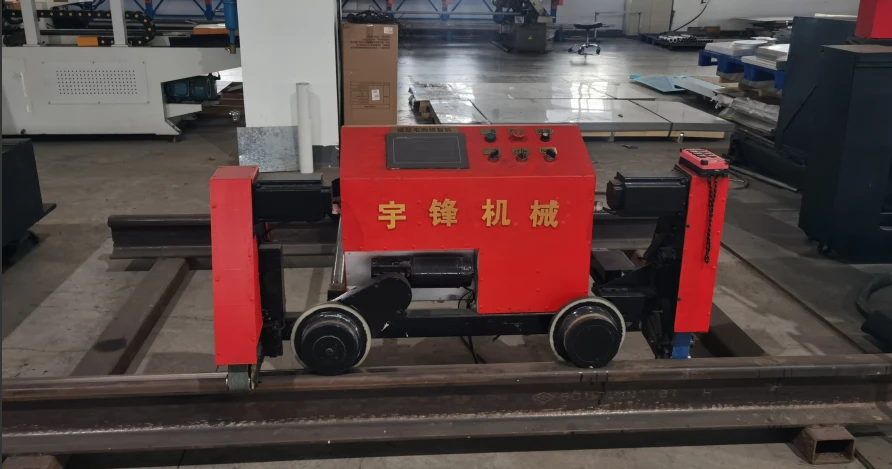
High-Speed Railway Turnout Repair Machine
Product Introduction:
This equipment is a rail maintenance tool specifically designed for the complex environment of high‑speed railway turnouts. It removes burrs, fish scale marks (shelling), and other rail surface defects, extending rail life and ensuring smooth train operation.
Core Advantages:
Adapts to complex and variable turnout environments
Compact structure – lightweight and portable – low operating and maintenance costs
Flexible belt grinding – low noise, high grinding quality
Grinding follows the rail profile – maximum protection of the original rail shape
Automatic control – eliminates manual grinding methods, reduces labor intensity

Applications
Maintenance of high‑speed railway turnouts (switches and crossings)
Removal of burrs, fish scale marks (shelling), corrugation, and other rail surface defects
Prevent rail cracks and surface fatigue, extending rail service life
Ensure smooth, quiet, and safe train operation at high speeds
Suitable for mainline railways, urban rail transit, and depot tracks
Selection Guide
Environment adaptability: must handle complex, confined, and variable turnout geometries
Portability: lightweight, compact, easy to carry to different track locations
Grinding method: flexible belt grinding (low noise, follows rail profile)
Control system: automatic or semi‑automatic to replace manual operations
Maintenance cost: low‑consumable design, easy replacement of grinding belts
Protection of rail profile: machine should follow the original rail shape without over‑grinding
Maintenance
Daily: clean dust and debris from the grinding unit and belt tracking system
Check grinding belt condition – replace if worn or clogged
Regularly lubricate guide wheels, bearings, and moving parts
Inspect dust extraction system (if equipped) – empty collector bag
Monthly: calibrate grinding pressure and belt tension; check electrical connections
Store in a dry case; protect electronic control unit from moisture
Factory Profile
Core technology with original innovation, multiple national invention patents
Provided key beveling equipment for the Hong Kong–Zhuhai–Macao Bridge
Product range includes turnout repair machines, CNC beveling machines, cold cutting machines, chamfering machines, portable drilling & tapping machines, marine lug root cleaning machines, etc.
Serving high‑speed railways, shipbuilding, bridges, offshore engineering, rail transportation, and heavy industry
Frequently Asked Questions (FAQ)
1. What typical rail defects can this machine remove?
The machine is designed to remove burrs, fish scale marks (also called shelling or spalling), minor corrugation, and surface cracks from high‑speed railway turnouts. It also smooths weld transitions and removes light flow marks.
2. Why is a dedicated turnout repair machine necessary?
Turnouts have complex geometry with variable rail sections, frogs, and moving parts. Standard rail grinders are too large or cannot follow the tight curves. Our machine is compact, lightweight, and adapts to the unique shape of turnouts.
3. Does it damage the rail profile?
No. The machine uses flexible belt grinding that naturally follows the existing rail contour. It removes only surface defects without altering the critical rail profile. This is a major advantage over rigid grinding wheels that can create flat spots.
4. Is it fully automatic or manual?
The machine features automatic control (speed, grinding pressure, travel) to eliminate heavy manual grinding work. The operator simply positions the machine and selects the program. However, manual override is available for fine adjustments.
5. What is the noise level compared to traditional grinding?
Flexible belt grinding generates significantly lower noise than rigid wheel grinding. Typical noise level is below 85 dB(A) at operator position, making it much more comfortable for night or urban maintenance work.
6. How portable is it? Can one person carry it?
The machine weighs approximately 25‑30 kg. It is designed with carrying handles and can be moved by one person for short distances, or by two people for longer positioning. The compact size allows use in confined track areas.
7. How often should the grinding belt be replaced?
Belt life depends on the severity of defects and total grinding length. Typically, one belt lasts for 50‑100 meters of grinding. Belt change takes less than two minutes and requires no special tools.
8. What power supply is required?
The machine runs on standard single‑phase 220V or 110V AC (configurable). Power consumption is around 1.5‑2 kW. It can be connected to a portable generator or railway maintenance vehicle power outlet.
9. Does it produce dust? Is there dust collection?
Yes, grinding generates fine dust (metal and abrasive particles). An optional dust extraction port can be connected to a vacuum system. For open track use, a dust collection bag is available to keep the work area clean.
10. Can it be used on regular (non‑high‑speed) rails?
Absolutely. While designed for high‑speed turnouts, it works equally well on conventional railway turnouts, tram tracks, and crane rails in industrial plants.
11. How does the machine follow the steel rail shape?
The machine is equipped with guide rollers that contact the rail head and gauge faces. The flexible grinding belt is pressed against the rail surface under controlled force, automatically conforming to the rail contour.
12. What safety features are included?
Emergency stop button
Protective cover over the grinding belt
Automatic power shut‑off if belt breaks or jams
Dust guard to prevent sparks flying toward operator
Ergonomic handles and anti‑slip feet for stable placement
13. Is operator training required?
We provide a user manual and video tutorial. Simple operation can be learned in 2‑3 hours. For best results, we recommend on‑site training (half a day) which our technicians can provide.
14. What is the typical service life of the machine?
With regular maintenance, the machine can operate for over 10 years. Wear parts (belts, bearings, guide wheels) are easily replaceable. The electric motor and control system are rated for heavy‑duty industrial use.
15. Do you offer a warranty?
Yes, we provide a 12‑month warranty on all mechanical and electrical components (excluding consumables like grinding belts). Lifetime technical support and spare parts are available.
Hot Tags: high-speed railway turnout repair machine, China high-speed railway turnout repair machine manufacturers, suppliers, factory