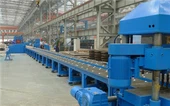
In the world of heavy forestry,land clearing,and biomass energy,few machines command as much respect as the drum-style chipper.While homeowners might be familiar with the small,gasoline-powered"disc"chippers found at suburban garden centers,the drum chipper is the industrial-grade titan of the timber world.
Whether it's turning a pile of storm-felled oaks into uniform mulch or supplying a pulp mill with the raw material for paper,the drum chipper is defined by one thing:relentless,high-volume efficiency.
What Exactly Is a Drum-Style Chipper?
At its core,a drum-style chipper is a heavy-duty machine designed to shear logs and branches into small,uniform pieces of wood(chips)using a cylindrical cutting rotor.
The name comes from its primary component:a massive,heavy steel drum-often weighing several tons-that rotates at high speeds.Unlike its cousin,the disc chipper,which uses a flat,pizza-pan-like flywheel with knives mounted on the face,the drum chipper mounts its knives parallel to the axis of the cylinder,much like the blades in an old-fashioned lawnmower or a wood planer.
Key Physical Characteristics
•The Rotor:A solid or fabricated steel cylinder.
•The Knives:Usually 2 to 6 long,heavy-duty steel blades bolted longitudinally onto the drum's surface.
•The Feed System:A set of horizontal hydraulic rollers that"choke"the log and pull it into the blades.
•The Anvil(Bed Knife):A stationary lower blade that the rotating knives pass against to create a"scissor"effect.
How It Works:The Anatomy of a Cut
The operation of a drum chipper is a masterclass in kinetic energy and hydraulic pressure.The process follows four distinct stages.
1.The Introduction(The Infeed)
The operator(often using a knuckleboom loader or crane)drops a log onto the infeed table.Unlike smaller chippers that rely on gravity or a person pushing,industrial drum chippers use hydraulic feed rollers.These rollers are spring-loaded or hydraulically pressurized to"bite"into the timber.They automatically sense the diameter of the wood and adjust their grip,pulling the log toward the drum at a consistent speed-usually 100 to 200 feet per minute.
2.The"Scissor"Shear(The Cut)
As the log hits the rotating drum,the knives make contact.This is where the magic happens.The rotating knife doesn't just"smash"the wood;it passes within a fraction of a millimeter of the stationary bed knife(anvil).
This creates a precision shearing action.Because the knives are set at a slight angle(the radial angle),they slice through the wood fibers cleanly across the entire width of the log in one smooth pass.This results in chips that are uniform in size-critical for paper mills,where inconsistent chips lead to uneven chemical cooking.
3.The Pocket and the Throw(The Discharge)
Once the wood is sliced,it doesn't just fall.The drum is engineered with scalloped pockets or"spout"areas behind each knife.As the drum spins,these pockets act like a centrifugal fan.They catch the freshly cut chips and hurl them violently against the back wall of the housing.
The air current created by the spinning drum then propels the chips up and through a discharge chute,launching them 20 to 50 feet away into a waiting chip van(trailer)or a designated pile.
4.The Safety Reversal(The Brain)
A drum chipper is smart.If the sensors detect a jerk in the drum's RPM-indicating a rock,a piece of metal,or a knot that is too tough-the hydraulic system instantly reverses the feed rollers.It spits the log back out,protects the knives from catastrophic damage,and waits for the operator to clear the tramp metal.
Drum vs.Disc:Why Choose a Drum?
If you are in the market for a chipper,the choice usually comes down to drum versus disc.Here is why a professional might choose the drum.
When it comes to cut quality,drum chippers produce excellent,highly uniform chips,while disc chippers tend to generate more fine particles and sawdust.This makes drums particularly attractive for applications like pulp production,where consistency directly affects downstream processing.
For handling square or irregularly shaped timber,drum chippers have a clear edge.Their straight knives cut the full width of a square beam in a single pass,whereas disc chippers often struggle with squared edges,leading to a rough,wavy finish known as washboarding.
In terms of power delivery,drum chippers offer higher torque,making them far better suited for large-diameter material-typically up to 30 inches or more.Disc chippers,by contrast,run at higher rotational speeds and are optimized for lighter,scrubby brush rather than heavy timber.
Maintenance also differs significantly between the two designs.Drum chipper knives are long and relatively easy to sharpen or replace on site.Disc chippers use many small segmented knives,which means more parts to change and more downtime during knife swaps.
Finally,fuel efficiency tends to favor the drum in heavy timber applications.A drum chipper delivers more"chips per gallon"when processing dense logs,while a disc chipper consumes more fuel simply to keep its heavy flywheel spinning at high RPM.
Taken together,these differences explain why drum chippers dominate industrial-scale operations where throughput,uniformity,and reliability are paramount.
The drum-style tree chipper is the heavy lifter of the forestry world.It is the machine you call when the trees are too big,the timber is too square,and the piles are too high.
By combining the brute force of a spinning steel cylinder with the surgical precision of a bed-knife shear,it transforms chaotic landscapes into a neat,uniform stream of green energy and pulp-ready fiber.It's not just a shredder;it's a high-precision industrial tool that turns the raw power of the forest into a measurable commodity.
What Exactly Is A Drum-style Tree Chipper, And How Does It Work?
Nov 13, 2026
Leave a message
You Might Also Like