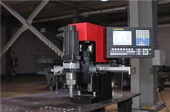
The drum in a drum-style tree chipper doesn't spin at one universal speed.Most commercial drum chippers run their cutting drum between 1,000 and 1,800 RPM,while industrial drum wood chippers often operate in a lower range-somewhere between 300 and 1,000 RPM-because their drums are physically larger and heavier.Small PTO-driven units may spin at around 540 RPM,which is the standard PTO speed for tractors.The exact number depends on the machine's size,the drum diameter,the number of knives,and what kind of material it's designed to process.
Typical RPM Ranges by Machine Class
Different classes of drum chippers are engineered for very different rotational speeds:
•Small PTO/tractor-mounted units:~540 RPM(standard PTO speed);some modern PTO drum chippers reach around 1,000 RPM
•Commercial brush/tree-service chippers:roughly 1,000–1,800 RPM
•Mid-size industrial drum chippers:commonly 590–730 RPM(e.g.,BX216-class machines at 590 RPM,BX213 at 730 RPM)
•Large whole-tree industrial chippers:larger drums often spin at the lower end of the spectrum to generate equivalent cutting force through mass and inertia.For example,the Morbark 50/48X whole-tree drum chipper runs its 48-inch drum at 945 RPM
•Upper extreme:some drum-type chippers are driven at 2,500–3,500 RPM,though these are less common in modern commercial tree-care equipment
Why Drum Size Matters More Than RPM
A common misconception is that"higher RPM=more cutting power."In reality,cutting force is a product of rotational speed and drum mass.A large,heavy drum spinning at 650 RPM can generate the same cutting force as a smaller drum spinning at 1,500 RPM.
Industrial specifications illustrate this principle clearly.The BX213 model features a 300 mm drum diameter and operates at 730 RPM with two flying cutters.Stepping up in size,the BX218 has an 800 mm drum spinning at 650 RPM,also with two cutters.The BX2113 increases to a 1,300 mm diameter and runs at 500 RPM with six cutters.At the largest end,the BX2120 is equipped with a massive 2,000 mm(2-meter)drum that rotates at just 295 RPM,utilizing six flying cutters.As the drum gets bigger,the RPM drops-but the knife tip still travels at substantial surface speed because of the larger radius.This is why a 2-meter drum at 295 RPM can still process 190 m³/h of material.
Factors That Determine Drum Speed
Manufacturers don't pick an RPM arbitrarily.Several engineering constraints shape the decision:
1.Drum diameter and mass-Larger drums carry more rotational inertia(300–800 kg for typical models),allowing them to run slower while maintaining cutting momentum
2.Number of knives-Drums with 2–4 knives need higher RPM to achieve the desired cuts-per-minute;drums with 6–10 knives can run slower
3.Target chip size-Chip length is determined by feed rate÷(RPM×knife count).To hit a specific chip length,engineers balance all three variables
4.Material type-Knotty,forked branches(common in tree service)benefit from aggressive,higher-RPM engagement;whole-tree milling prioritizes torque and mass
5.Drive power-Engine horsepower(from 30 kW up to 1,200 HP in the largest units)sets the ceiling on how fast a given drum can be spun under load
The Cutting Action at Speed
At 1,000–1,800 RPM,the knives on a drum chipper are striking the wood thousands of times per minute.This high frequency,combined with hydraulic feed rollers pushing material aggressively into the drum,is what gives drum chippers their characteristic"pulling"feel-the operator doesn't have to force branches into the chute.
This aggressive engagement is also why drum chippers excel at handling irregular,heavy limbs that disc chippers might struggle with.However,it's also why drum chippers tend to produce slightly longer,more stringy chips compared to the uniform squares from disc chippers.
Safety Implications of High Drum Speeds
The combination of high RPM,exposed knife edges,and aggressive self-feeding creates serious hazards.Industry standards such as ANSI/OPEI B71.9(USA),EN 13525(Europe),and OSHA machine-guarding requirements mandate specific safety features:
Critical safety systems on modern drum chippers:
-Emergency stop buttons at the operator station,engine panel,and infeed chute
-Upper cover interlocks-opening the drum housing automatically cuts power to the rotor motor
-Auto-feed reversing-detects jams and reverses the feed rollers without operator intervention
-Two-handed infeed controls-keep the operator's hands away from the throat
-Full drum enclosure in heavy-gauge steel housing
The LY/T 1796-2025 standard(China's wood-based panel chipper safety standard)specifically requires that"when the upper cover is opened,the control power to the cutter roller...should be automatically cut off."This directly addresses the high-risk scenario of a maintenance worker accidentally starting the machine while inspecting blades.
Practical Takeaway
If you're operating or specifying a drum-style tree chipper,here's what you actually need to know:
•For tree service/brush clearing(handling 6–12 inch material):expect a drum speed in the 1,000–1,800 RPM range
•For whole-tree/biomass operations(processing full trees):the drum will likely spin at 800–1,000 RPM with a much larger diameter
•For industrial pulp/panel feedstock:fixed drum chippers typically run 300–750 RPM with drums up to 2 meters in diameter
The drum's RPM is always a carefully engineered balance-never attempt to modify it.The speed is matched to the drum's mass,the knife count,the feed system,and the chip-size target.Changing it without re-engineering the entire system risks catastrophic mechanical failure,poor chip quality,and severe safety hazards.
Always consult the manufacturer's specification plate for the exact rated drum speed of your particular machine,and follow all ANSI,OSHA,or EN 13525 safety protocols during operation and maintenance.
How Fast Does The Drum Spin in A Drum-style Tree Chipper?
Aug 22, 2026
Leave a message
You Might Also Like