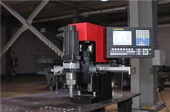
A drum-style tree chipper does not produce one fixed chip size.Instead,it converts logs,branches,tops,and wood waste into uniform chips whose dimensions are adjustable,with the typical industrial output falling in the range of about 10 mm to 40 mm in length(roughly 0.4–1.6 inches).Depending on the machine configuration and the downstream application,the chips can be further classified as follows:
•Biomass/fuel chips:5–25 mm,optimised for dense,consistent combustion in boilers and gasifiers.
•Pulp chips(paper industry):20–35 mm,the standard length for chemical and kraft pulping.
•Panel-board feedstock(particleboard,MDF,HDF):30–40 mm is the norm,though smaller 10–15 mm chips are often specified for wood-pellet lines.
•Mobile/whole-tree chippers:Drum machines such as the Peterson 4300B generate chip lengths of 3–32 mm(⅛–1¼ in),showing that even high-capacity field units stay within the same order of magnitude.
In practice,most drum chippers are set to deliver chips between 20 mm and 40 mm,which balances throughput,energy consumption,and product quality for the majority of forestry,landscaping,and biomass operations.
What Determines the Exact Chip Size?
The drum chipper's design gives the operator several levers to fine-tune the output dimension:
1.Feed speed vs.drum speed–The nominal chip length can be approximated by the relation
L\approx\frac{\text{feed speed}}{\text{drum rpm}\times\text{number of knives}}
Hence,a slower feed rate or a faster drum(or more knives)yields shorter chips.
2.Knife configuration–The number of knives on the drum(typically 2–12)and their projection angle directly set the chip length.More knives→shorter chips;fewer knives→longer chips.
3.Anvil(counter-knife)gap–The clearance between the rotating knife and the stationary bed knife is critical.A gap of 0.5–1.5 mm produces a clean shear with minimal"tails"or fines,whereas a wider gap tears the fibre and enlarges the chip.
4.Screen aperture–Below the drum sits a perforated screen;only chips small enough to pass through the holes are discharged.Swapping screens changes the maximum allowable chip dimension,allowing the same machine to switch from coarse biomass chips to fine pellet-feed stock.
5.Raw material characteristics–Wood species(hardwood versus softwood),moisture content,and diameter all influence the final size.Wet or dense hardwoods tend to generate slightly larger,less uniform chips,while dry softwoods chip more predictably.
Because of these adjustable parameters,a single drum chipper can be re-configured on site to meet contrasting specifications-from sub-5 mm biomass pellets to 50 mm+chunks for erosion control or further milling.
Why Chip Size Matters
The dimensions of the chips dictate how they can be used:
•Energy&pellets:Uniform chips of 10–45 mm flow smoothly through automated boiler feed systems and produce stable combustion;finer 5–20 mm chips are preferred for pelletising.
•Pulp&paper:Tight length control(≈20–35 mm)and low fines(<5 %)are essential for high pulp yield and consistent cooking.
•Landscaping&mulch:Medium chips(20–50 mm)provide cushioning for playgrounds and pathways,while larger 30–50 mm pieces are favoured for decorative tree rings and slope stabilisation.
•Composting&soil amendment:Smaller chips(10–20 mm)decompose faster,adding carbon and improving soil structure.
In short,a drum-style tree chipper is a versatile size-adjustable machine.Typical industrial output is 10–40 mm,with the sweet spot for most pulp,panel,and biomass applications sitting around 20–35 mm.By manipulating knife count,drum speed,feed rate,anvil gap,and screen size,operators can reliably hit whatever specification their market demands-whether that is fine fuel for a pellet mill or coarse chips for landscape mulch.